What to Do If You Fail the Irish Driving Test
Roughly half of all candidates fail the Irish driving test on their first attempt. If you're one of them, the path forward is well-defined: read your report, fix the specific issues it flags, reapply through MyRoadSafety, and retake the test. This guide walks through every step.
Reading Your Test Report
The most important document you leave the test centre with is your printed test report. It lists every fault the examiner marked, in order, grouped into three grades:
- Grade 1 (minor) — small lapses that do not affect your overall result on their own. Useful as feedback, but not the source of your failure.
- Grade 2 (serious) — significant faults that compromise safety or comfort. You can accumulate up to 8 Grade 2 faults without failing, provided they don't form a pattern of significant deficiency in any single category.
- Grade 3 (dangerous) — a single Grade 3 fault is an automatic fail, regardless of how the rest of the test went.
Don't read your report once and put it away. Show it to your ADI (Approved Driving Instructor). Most failures cluster around two or three repeating issues — a habitual mirror-check pattern, a particular junction type, or a specific manoeuvre. Your instructor can usually pinpoint the underlying habit driving most of the marks within a single lesson.
Common Reasons People Fail in Ireland
Across thousands of failed tests every month, the same handful of fault types appear repeatedly:
- Inadequate observation — failing to visibly check at junctions, missing a vehicle in your blind spot, or rolling out of a stop without an obvious head check.
- Incorrect road position — drifting toward the centre line, taking the wrong lane on a roundabout, or sitting too close to parked cars.
- Failing to respond correctly to traffic lights and signs — late stops, missed give-way obligations, ambiguous signalling.
- Mirror checks before manoeuvring — examiners need to see your head turn. Quick glances that don't visibly register often get marked.
- Manoeuvre errors — clipping the kerb on a reverse around a corner, rolling backwards on a hill start, drifting wide on a turnabout.
Most of these aren't skill problems — they're visibility problems. The examiner can only credit what they can see you doing. Targeting your retest practice on visible-observation habits typically moves the needle more than working on technique.
Reapplying for the Driving Test
You can reapply immediately — there is no compulsory waiting period imposed by the RSA. The application takes around 10–15 minutes. You'll need:
- Your driver number and PPS number.
- A valid learner permit — your permit must still be in date when you apply. If it's expiring soon, renew it at NDLS first.
- A debit or credit card for the fee.
- A valid email address for booking confirmations.
Apply through MyRoadSafety.ie (the RSA's online portal) — you can also apply via rsa.ie or by post if needed. Once you submit your application you go into an invitation queue. You'll be invited to book a slot when one becomes available, with priority handled by the centre's existing waiting list.
When applying, specify your nearest test centre — but consider whether your nearest centre is the right one. Pass rates and waiting times vary substantially. A 6-month wait on your local centre may be worse value than a 3-week wait at a centre an hour away. See live pass rates by centre and current waiting times.
Driving Test Fees
As of 2025, the standard Category B (car) driving test fee is €85, payable each time you sit the test. The fee for a retest is the same as for your first attempt — there's no discount for repeat candidates. Different categories (motorcycle, HGV, bus) have different fees set by the RSA.
Fees are subject to change. Always check rsa.ie for the most current figure before paying.
Preparing for the Retest
The candidates who pass on the second attempt almost always do so because they targeted their practice on the specific issues their first report flagged. A loose plan:
- Take your report to your ADI. Book a one-hour lesson specifically focused on diagnosing what's behind the recurring marks.
- Practise the actual test routes used at your booked centre. The route geography is fixed — the routes don't change for your retest. Practising them removes the surprise factor and frees attention for technique.
- Re-do the manoeuvres that went wrong. Manoeuvres are graded harshly, and they're the easiest fault category to fix with focused practice — usually 2–3 hours on a quiet residential road resolves most issues.
- Book a mock test with your ADI under examiner-style conditions. No coaching during the drive; full debrief after. This catches habits that only show under pressure.
The single biggest leverage point is the second one — practising your centre's actual test routes. The Driving Test Routes Ireland app maps every active route at all 60 RSA centres, with manoeuvre points and hazard zones annotated. If you didn't use it before your first attempt, this is the time.
Booking a Short-Notice Retest
MyRoadSafety.ie has a short-notice retest feature that lists slots freed up by other candidates' cancellations. These slots disappear in minutes when they appear, so:
- Log in to the portal regularly — once or twice a day if you're keen.
- Have your card details and confirmation email open and ready.
- Don't be too picky about the exact time slot. A 7am Tuesday is still a test date.
Short-notice slots are most common at busy urban centres because they have more cancellations. Quieter rural centres have less churn and therefore fewer short-notice openings. For the full playbook on catching cancellations, see how to get an earlier driving test.
Appealing a Failed Test
You can appeal a fail only if you believe the test was not conducted according to regulations. An appeal is not a way to challenge the examiner's judgement on driving — it's specifically for procedural irregularities (e.g. the examiner instructed you incorrectly, the route was unsafe, the test conditions were not standard).
Key facts:
- 14-day deadline — you must file the appeal within 14 days of receiving your test result.
- Filed with the District Court under the Road Traffic Act 1961.
- Specific evidence required — bring details about test conditions, examiner conduct, or any procedural breach you observed.
- Outcome — if the court accepts your appeal, it can order a retest under more favourable conditions. It cannot retroactively change your result.
For most candidates, appealing is not the right path — even if the test felt unfair. The bar is procedural, not subjective. The faster route back to the road is almost always reapplying through MyRoadSafety.
After You Pass on the Retest
Once you pass, the examiner gives you a Certificate of Competency on the day. This is valid for two years and is what you take to NDLS to apply for your full Irish driving licence.
Two notes that catch some candidates out:
- Your full licence application is a separate step — the Certificate of Competency by itself doesn't let you drive unaccompanied. Apply at ndls.ie or in person at an NDLS centre.
- For the first two years of your full licence, you're in the novice driver phase and must display N plates instead of L plates. Penalty thresholds are also lower during this phase.
Practice Real Test Routes on Your Phone
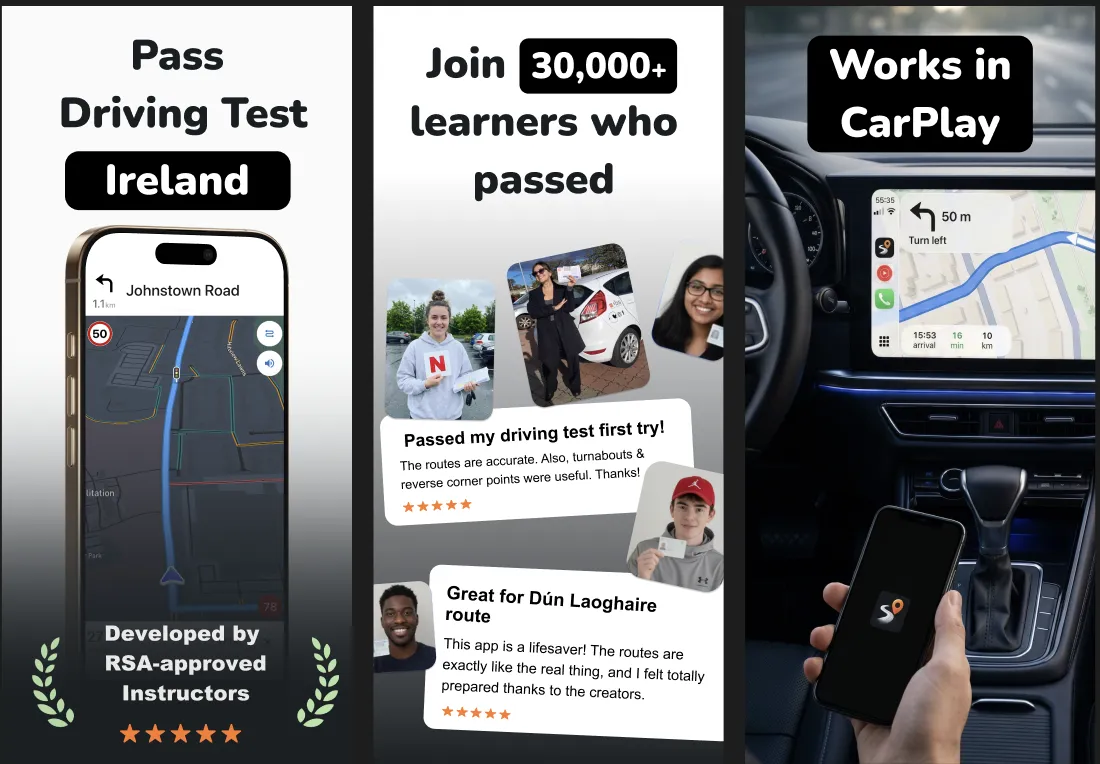
The only Irish driving test app with CarPlay, real-time speed limit alerts, stop sign detection, and AI-powered drive analysis. 300+ routes across all RSA centres.

Renew your Driver Theory Test before it lapses
DTT certificates are valid for two years. If yours is approaching expiry while you're waiting for a retest, you'll need to sit the theory test again before you can renew your learner permit. The DTT Car & Bike app walks you through the full official question bank with mock tests in the same format as the real exam.
Frequently Asked Questions
How soon can I reapply after failing?
Immediately, through MyRoadSafety.ie or RSA.ie. There's no compulsory waiting period — but the actual retest date depends on your chosen centre's waiting list.
How much does it cost to retake the test?
€85 for a Category B (car) test as of 2025, the same as your first attempt. Always verify the current fee on rsa.ie before paying.
How many faults can I get and still pass?
You can accumulate up to 8 Grade 2 faults without failing (provided they don't form a pattern in one category). A single Grade 3 (dangerous) fault is an automatic fail. Grade 1 faults don't affect your result.
Can I appeal the result?
Only on procedural grounds — within 14 days, to the District Court under the Road Traffic Act 1961. Not a path for disputing the examiner's driving assessment.
Can I book a short-notice retest?
Yes — the MyRoadSafety.ie short-notice feature lists cancellation slots. They go fast, so check daily and have payment details ready.
What documents do I need to reapply?
Driver number, PPS number, valid learner permit, debit/credit card, and a valid email. For the test itself, bring your learner permit, signed EDT logbook, and proof the test vehicle is taxed, insured, NCT-valid and roadworthy.