Manual vs Automatic Driving Test in Ireland
It looks like a simple choice — clutch or no clutch — but the licence you get out of it has consequences for years. Here's the trade-off, plus when each option actually makes sense.
Pass your test in a manual and you can drive both manual and automatic cars for life. Pass in an automatic and your licence is restricted (code 78) — you can never drive a manual car without applying for a new learner permit and re-sitting the test. If you might ever want to drive manual (a friend's car, a hire car abroad, a job-related vehicle), learn manual.
The Key Licence Difference: Code 78
Whichever transmission you sit your test in determines your licence:
- Manual licence — pass your test in a manual car and you can drive both manuals and automatics on Irish roads. Maximum flexibility.
- Automatic licence (code 78) — pass in an automatic and your licence carries a code 78 restriction. You're legally limited to automatic vehicles only.
If you started on an automatic and later want to drive a manual, you can't simply book a manual lesson and start driving. You'd have to apply for a new learner permit and re-sit the practical test in a manual car. That means new fees, new EDT lessons, and a new wait for a test slot.
Side-by-Side Comparison
| Aspect | Manual | Automatic |
|---|---|---|
| Licence flexibility | Drive both manual + automatic | Code 78 — automatic only |
| Learning curve | Steeper — clutch and gears to master | Easier — fewer controls |
| Lesson cost (per hour) | €50–€65 | Often slightly cheaper |
| Risk of stalling | Higher (especially on hill starts) | Effectively zero |
| City traffic | More tiring in stop-start traffic | Considerably easier |
| Rural/hilly driving | More control in varied terrain | Adequate, less responsive |
| Future EV/hybrid | Manual licence drives both anyway | Most EVs/hybrids are automatic — fine |
| Vehicle availability | Wider used-car market | Growing, especially newer cars |
When Manual Makes Sense
Choose manual if any of these apply:
- You might drive someone else's car — family, friends, work pool cars. The Irish used-car market still has plenty of manuals; a code 78 restriction rules them out.
- You drive in rural Ireland — hilly roads, narrow lanes, and varied terrain often benefit from the precise control a manual gearbox gives.
- You travel and might rent cars abroad — manual hire cars are still the cheaper option in much of Europe, and your Irish manual licence translates straightforwardly.
- You want maximum future-proofing — a manual licence covers everything, including any car you'll own for the next few decades.
Trade-offs: more lessons to master clutch control, higher chance of stalling early on, slightly higher per-hour lesson cost, and a longer overall learning timeline before you're test-ready. Most learners who are committed to manual budget for a few extra hours of practice.
When Automatic Makes Sense
Choose automatic if any of these apply:
- You drive primarily in Dublin or another big city — heavy stop-start traffic is significantly less stressful in an automatic, and the volume of pedestrian/cyclist hazards in city driving means you'll appreciate the cognitive load saving.
- You're planning to drive an EV or hybrid — these are automatic by design. If your next car is electric (a growing share of the Irish fleet), the code 78 restriction is irrelevant.
- You have physical limitations — knee, ankle, or hip mobility issues are much easier in a two-pedal automatic than a three-pedal manual.
- You want to pass faster — automatic learners tend to need fewer lessons and the test itself is mechanically simpler.
Trade-offs: the code 78 restriction is permanent unless you re-sit in a manual. Used-car selection is narrower for automatics in Ireland, particularly at the lower end of the price range, though this is changing fast.
EDT, Test Routes, and Practice
One thing both groups have in common: 12 hours of Essential Driver Training (EDT) with an Approved Driving Instructor before you can sit the test, regardless of transmission. Your EDT logbook records each session, and you must present it on test day.
Practice your EDT lessons in the same transmission you intend to be tested in. There's no benefit to alternating — the muscle memory and skill set is different enough that you'll just confuse yourself.
The other thing both groups share: the test routes are the same regardless of transmission. The examiner picks from the same fixed set of routes around your test centre, and the manoeuvres are identical. Practising those specific routes before test day is the highest-leverage thing you can do — and it works equally well for either licence type. The Driving Test Routes Ireland app maps every active route at all 60 RSA centres.
Switching from Automatic to Manual Later
If you've already passed in an automatic and want to upgrade to a full manual licence, the process is essentially restarting:
- Apply for a new learner permit for category B (manual) at NDLS.
- You'll need to satisfy the EDT requirement again in a manual vehicle (some learners can do an abbreviated version — confirm with your ADI).
- Hold the permit for 6 months — the standard waiting period applies.
- Book and sit a new practical test, this time in a manual car.
- Pay the standard €85 test fee. There's no discount for already holding an automatic licence.
In practical terms, that's months of time and several hundred euro you wouldn't have spent if you'd just learned manual to begin with. It's worth weighing carefully before opting for the easier automatic path.
Procedural details change occasionally — verify the current rules at rsa.ie before relying on them for a major decision.
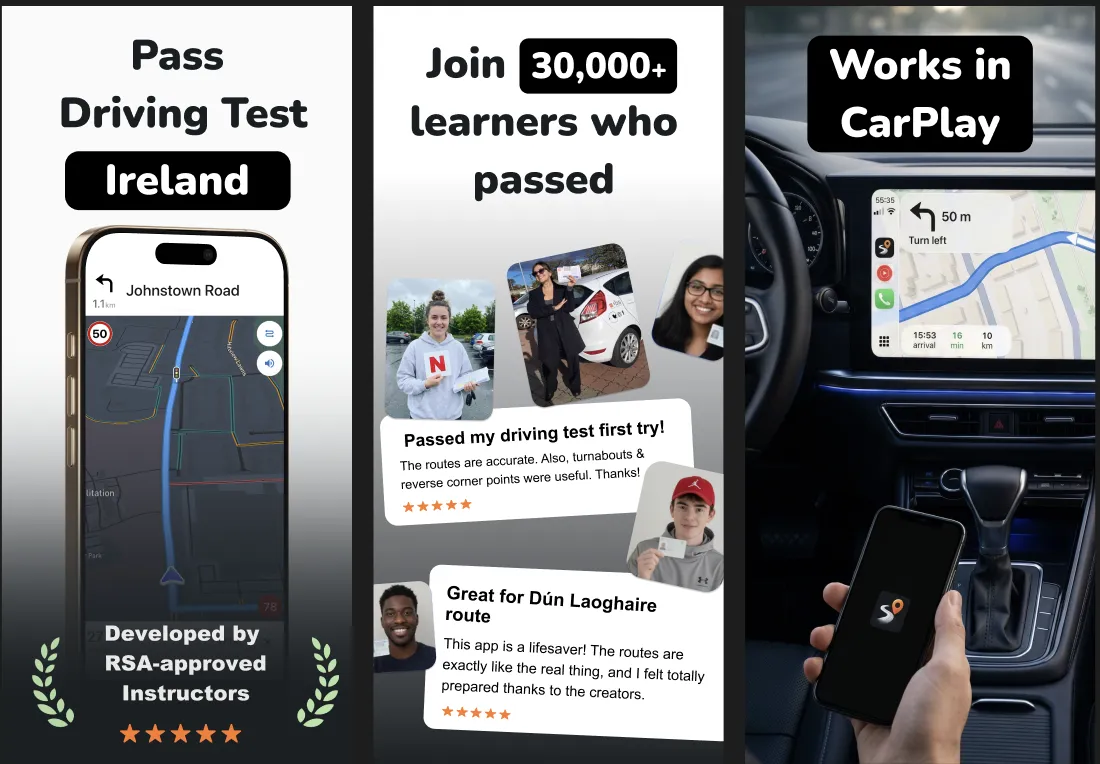
Practice Real Test Routes on Your Phone
The only Irish driving test app with CarPlay, real-time speed limit alerts, stop sign detection, and AI-powered drive analysis. 300+ routes across all RSA centres.

Frequently Asked Questions
Can I drive a manual car if I pass in an automatic?
No. Your licence carries a code 78 restriction limiting you to automatic vehicles. To drive manual, you'd need to apply for a new learner permit and retake the test in a manual car.
Is the test easier in an automatic?
Most learners find it mechanically simpler — no clutch, no stalling, no gear-changes. The examiner still assesses observation, road position, manoeuvres and signalling to the same standard, but with one less fault category, candidates often pass sooner.
How much do lessons cost?
Manual lessons in Ireland typically run €50–€65 per hour. Automatic is often slightly cheaper. Total spend across mandatory EDT plus extra practice is usually €600–€1,200.
Can I take EDT in automatic and the test in manual?
Practice and test in the same transmission. The skills don't fully transfer — your muscle memory for clutch control develops only with manual practice.
Are electric vehicles automatic?
Yes. EVs and most hybrids have no clutch or traditional gearbox. If your future car is electric, an automatic licence is sufficient.
Does it matter which transmission for centre choice?
No — every RSA test centre tests both manual and automatic candidates on the same routes. Pick your centre based on pass rate and waiting time, not transmission.