How to Pass the Irish Driving Test in 2026
The national pass rate for the RSA Category B driving test currently sits at 55.3%, meaning roughly half of all candidates fail on their first attempt. This guide walks through everything you need to know — from the mandatory 12 EDT lessons to picking a centre, what the examiner is actually looking for, and a 14-day plan to give yourself the best chance of passing first time.
Before You Apply
You can't just book a driving test in Ireland — there's a sequence you have to complete first. Skipping or mis-ordering any step delays you by months.
- Pass the Driver Theory Test (DTT). Multiple-choice, sat at a Prometric centre, valid for two years. You can't apply for a learner permit without a valid DTT pass. If you haven't passed yet, our DTT Car & Bike app walks you through the full official question bank with mock tests in the same format as the real exam.
- Apply for a Category B learner permit at an NDLS centre. Bring your DTT certificate, proof of address, and PPSN. The permit is valid for two years.
- Hold the learner permit for at least 6 months before you're eligible to sit the practical test. This is a hard rule — you can't shortcut it.
- Complete 12 hours of Essential Driver Training (EDT) with an Approved Driving Instructor (ADI). Each lesson is logged in your EDT logbook by the instructor; the logbook must be signed and presented at your test.
For exact current fees, the up-to-date list of NDLS appointment locations, and any recent rule changes, always check rsa.ie — these details change periodically.
EDT Lessons and Independent Practice
The 12 EDT lessons cover the core curriculum the RSA expects every learner to have been formally taught — vehicle controls, vulnerable road users, basic and complex manoeuvres, anticipation, motorway driving, and night driving (depending on the time of year). Each lesson is around an hour and must be at least three days apart from the previous one.
Twelve hours is the legal minimum, not the practical minimum. Most candidates who pass first time have done 30–60 hours of total driving — formal EDT plus extensive practice with a sponsor (a fully-licensed driver who's held their licence for at least two years).
When practising with a sponsor:
- L plates must be displayed front and back of the vehicle.
- Your sponsor must be in the passenger seat at all times.
- You can't drive on motorways as a learner.
- The vehicle must be insured, with you named on the policy as a learner driver.
Choosing the Right Test Centre
You can sit the test at any RSA centre — your home address doesn't restrict you. This matters because pass rates and waiting times differ enormously between centres. Three things to weigh:
- Pass rate — the spread between centres is real and persistent. Live pass rates by centre are updated monthly from CSO data.
- Waiting time — Dublin centres can have 20+ week waits while some rural centres are sub-5 weeks. See current waiting times by centre.
- Route familiarity — every centre uses a fixed set of test routes. Practising your actual centre's routes is the closest thing to a sure-fire prep step.
For city-by-city rankings:
What the Test Actually Involves
The Category B driving test takes around 40 minutes total. Allow 60–75 minutes including check-in and the post-test debrief.
- Check-in and document review — you present your learner permit, signed EDT logbook, and proof that the test vehicle is properly insured, taxed, and roadworthy. The examiner won't proceed if any of these are missing.
- Vehicle safety questions — short oral questions about your car's controls and safety equipment. Common ones: how to check tyre pressure, where the engine oil dipstick is, what the dashboard warning lights mean, how to operate hazard lights, demisters, headlights, and indicators.
- Manoeuvres — you'll be asked to perform two of: reverse around a corner, turn-about (three-point turn), parallel park, or hill start. The examiner picks at random.
- On-road driving — roughly 25–30 minutes covering urban, suburban, and rural roads, multiple junction types, roundabouts, and likely some dual-carriageway driving. The route is one of a fixed set the examiner picks from on the day.
- Debrief — back at the centre, the examiner walks you through your faults, gives you the result, and prints your report.
The Grading System
The examiner marks faults in three grades:
- Grade 1 (minor) — small lapses that don't materially affect safety. These don't fail you on their own.
- Grade 2 (serious) — significant faults that compromise safety or comfort. Accumulating multiple grade-2 faults of the same type fails you.
- Grade 3 (dangerous) — single dangerous fault that creates a real risk. Any one grade-3 fault is an automatic fail, regardless of the rest of your test.
The exact thresholds for grade-2 accumulation (how many of the same type, plus combined-category limits) are set by the RSA and occasionally revised. Your instructor will know the current numbers — and the examiner will explain the result if you fail.
Common Reasons People Fail
ADI instructors and the RSA's own published reports consistently flag the same handful of fault types as the most common reasons for failure. Most of them are observation-related, not skill-related — drivers who can technically drive fail because they don't visibly check.
- Inadequate observation at junctions and roundabouts — failing to check effectively before pulling out, missing a vehicle in your blind spot, or rolling out of a stop without visibly looking both ways.
- Mirror checks before manoeuvring — examiners need to see your head turn. A glance that's too quick to register doesn't count.
- Incorrect road position — drifting toward the centre line, taking the wrong lane on a roundabout, or sitting too close to parked cars.
- Failure to use indicators correctly — signalling too late, too early, or not at all when changing lanes or pulling away.
- Speed — both directions matter. Drifting over the limit fails you, but so does hesitating at 30km/h on a 50km/h road and obstructing traffic.
- Reverse around the corner — clipping the kerb, drifting wide, or not checking over the right shoulder enough.
- Hill starts and clutch control — rolling backward at a hill stop, stalling at a junction, or jumping forward when the lights change.
14-Day Preparation Plan
Two weeks of focused practice before your test is a sensible minimum. Here's a structure that mirrors what most ADIs recommend:
- Days 14–10 — pretest lesson with your ADI on the actual routes used at your booked centre. Use the Driving Test Routes Ireland app to identify them.
- Days 9–6 — repeat practice on the test routes with your sponsor. Focus on the specific junctions and manoeuvre points you struggled with in your ADI lesson.
- Days 5–3 — full mock test under examiner-style conditions. Your ADI gives no help, marks faults, and debriefs as if it were the real thing.
- Day 2 — review only. No long drives. Read the rules of the road, run through the vehicle safety questions, double-check your test vehicle's documents.
- Day 1 (test day) — light familiarity drive only. Eat, sleep, arrive 15 minutes early.
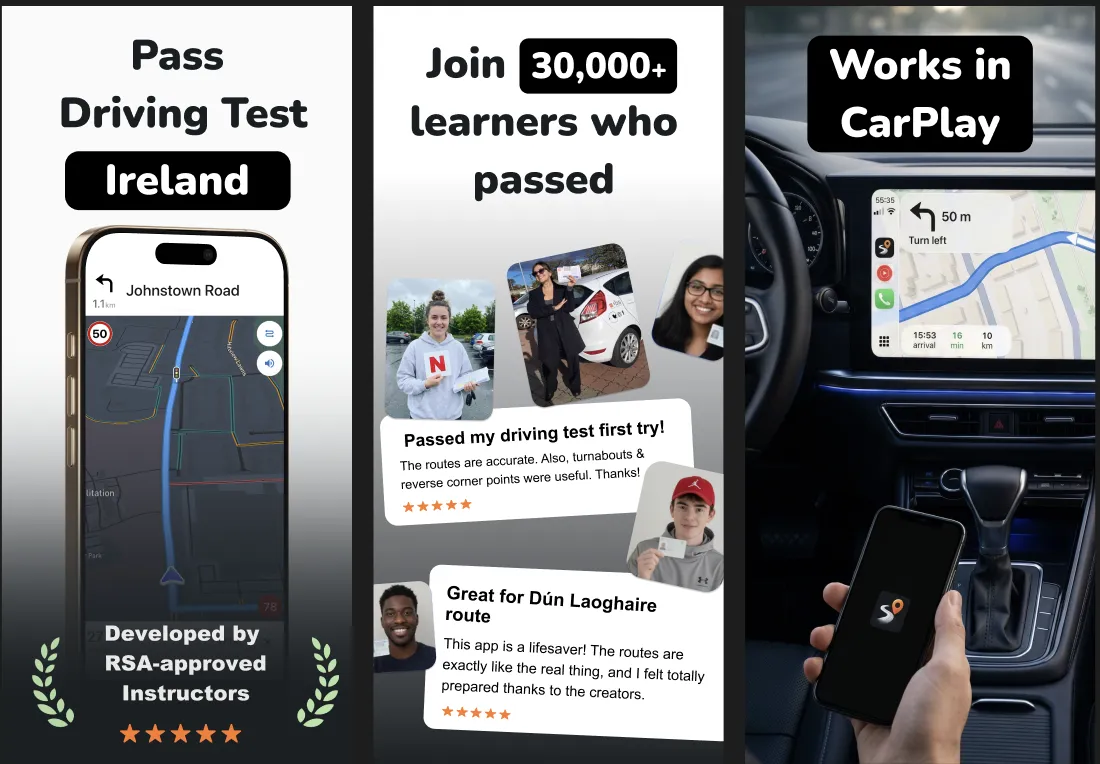
The single biggest leverage point in this plan is practising the actual routes used at your booked centre. Test routes are not random — examiners pick from a fixed set around each centre, and that set rarely changes. The Driving Test Routes Ireland app maps every active route at all 60 RSA centres.
Practice Real Test Routes on Your Phone
The only Irish driving test app with CarPlay, real-time speed limit alerts, stop sign detection, and AI-powered drive analysis. 300+ routes across all RSA centres.

On the Day of the Test
A short checklist for the morning of your test:
- Documents — current learner permit, signed EDT logbook, and the booking confirmation email.
- Vehicle — taxed, insured (with you named as a learner), NCT-valid, with two L plates clearly displayed. The examiner will refuse to proceed if any of these are missing.
- Inside the car — clean enough that the examiner has somewhere to put their feet. Make sure indicators, lights, and demisters all work, and that you've topped up wiper fluid.
- Yourself — arrive at least 15 minutes early. Glasses if you wear them. A bottle of water for the wait. Comfortable shoes.
During the test, the examiner is not there to trick you. Their job is to assess whether you're safe to drive unsupervised. Drive as you would on a quiet practice run — confidently, methodically, with visible checks. Don't second-guess every movement. If you make a small mistake (a missed gear, a wide turn) just continue calmly; one grade-1 doesn't fail you, but tensing up and making three more in the next minute might.
After the Test — Pass or Fail
If you pass: the examiner gives you a Certificate of Competency on the day. You then apply for your full driving licence at NDLS within two years. Once you've got your full licence, the L plates come off and the two-year novice "N" plate phase begins.
If you fail: the examiner walks you through every fault marked, in order, and gives you a printed report. Take the report home and show it to your ADI — they'll often spot a single recurring habit that's responsible for most of the marks. You can re-apply for another test as soon as you're ready; there's no compulsory waiting period, but the booking queue at your centre still applies. Many candidates pass second time after another 5–10 hours of focused practice on the specific issues their report flagged.
All RSA Driving Test Centres in Ireland
Click any centre below for its current pass rate, waiting time, monthly trend charts, and the test routes used there. Centres are grouped by county.
Co. Carlow
- Carlow — 56% pass rate
- Carlow (Talbot Hotel) — 51.3% pass rate
Co. Cavan
- Cavan — 58.9% pass rate
Co. Cork
- Cork (Wilton) — 51.6% pass rate
- Mallow (Cork Racecourse) — 57.1% pass rate
- Mitchelstown — 50% pass rate
- Skibbereen — 52% pass rate
Co. Donegal
- Buncrana — 67.4% pass rate
- Donegal Town — 63.6% pass rate
- Letterkenny — 60.6% pass rate
Co. Dublin
- Dún Laoghaire — 48.6% pass rate
- Finglas — 48.7% pass rate
- Killester — 47.4% pass rate
- Mulhuddart — 41.8% pass rate
- Mulhuddart Maple House — 51.7% pass rate
- Raheny — 48.6% pass rate
- Tallaght — 49.7% pass rate
Co. Galway
- Clifden — 67.9% pass rate
- Galway — 63.2% pass rate
- Galway (Clybaun Hotel) — 55.8% pass rate
- Loughrea — 63.6% pass rate
- Loughrea (Hotel & Spa)
- Tuam — 54.3% pass rate
Co. Kildare
- Naas — 52.6% pass rate
Co. Kilkenny
- Kilkenny — 47.4% pass rate
- Kilkenny (O'Loughlin Gaels) — 51.9% pass rate
Co. Laois
- Portlaoise
- Portlaoise (Maldron Hotel) — 57.2% pass rate
Co. Leitrim
- Carrick-on-Shannon — 63.3% pass rate
Co. Limerick
- Limerick — 58.6% pass rate
- Limerick (Woodview) — 48.5% pass rate
- Newcastle West — 62.5% pass rate
- Newcastle West (Longcourt House) — 71.2% pass rate
Co. Longford
- Longford — 57.7% pass rate
Co. Meath
- Navan — 57.8% pass rate
Co. Monaghan
- Monaghan — 58.2% pass rate
Co. Roscommon
- Roscommon — 66% pass rate
Co. Sligo
- Sligo — 50% pass rate
Co. Tipperary
Co. Wicklow
- Wicklow — 46.3% pass rate
Frequently Asked Questions
What is the pass rate for the Irish driving test?
The current national average pass rate sits at 55.3%. It varies enormously by centre — see live pass rates by centre.
How long is the Irish driving test?
The full Category B test takes about 40 minutes — vehicle safety questions, two manoeuvres, and 25–30 minutes of on-road driving.
How many lessons do I need before sitting the test?
12 hours of EDT with an Approved Driving Instructor is the legal minimum. You also need to have held your learner permit for at least 6 months. Most successful candidates do significantly more practice on top of the mandatory 12.
What are the most common reasons people fail?
Observation faults (junctions, roundabouts, mirror checks before manoeuvres), incorrect road position, signalling errors, and accumulating multiple grade-2 faults of the same type. A single grade-3 (dangerous) fault is an automatic fail.
Can I retake the test if I fail?
Yes — there's no compulsory waiting period. Re-apply through MyRoadSafety as soon as you're ready, but factor in your centre's current waiting list.
Does it matter which test centre I choose?
Yes. Pass rates differ by 30+ percentage points between the highest and lowest centres, and waits range from 3 to 20+ weeks. You can choose any centre when you book — see the city-by-city guides for recommendations.